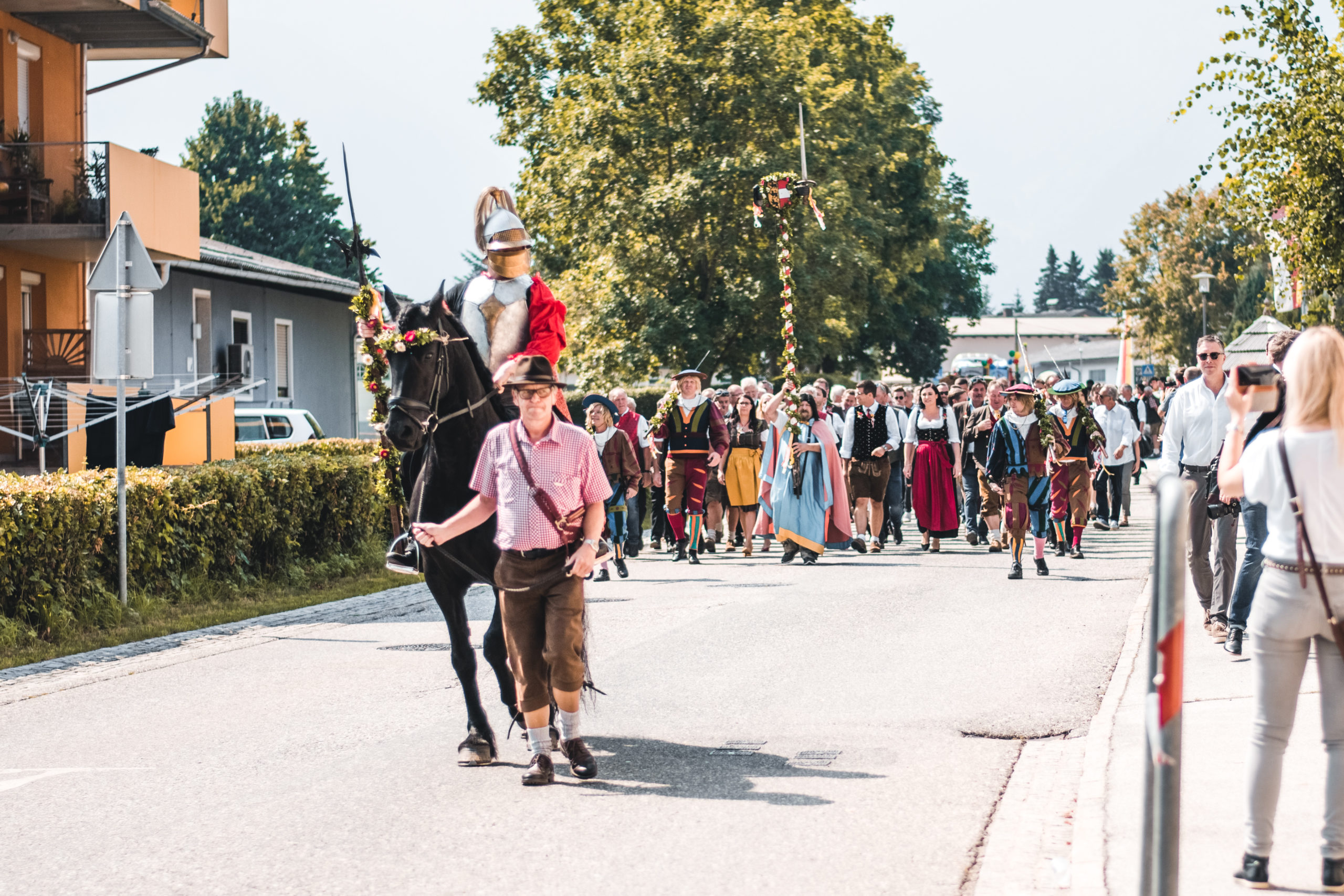
The Bleiburg Wiesenmarkt – the largest and oldest traditional folk festival in Lower Carinthia – has been held since 1393 and will take place this year from Friday, 4 September to Monday, 7 September 2026.
99 Years Before the Discovery of America
In order to promote the development of the town of Bleiburg, which was facing severe economic hardship following extensive devastation, Duke Albrecht granted the town the right to hold a Wiesenmarkt on 16 March 1393, to take place on 15 August. The very first market led to serious disputes, and on 10 September 1393 a dedicated town judge was elected to settle them. Probably the most important of these town judges was Hanns Katschnik, who in 1428 drew up an agreement between the town of Bleiburg and the respective owner of the meadow concerning the right to use the land. This agreement remains valid to this day and is one of the oldest legal customs in Europe still in force!
Ever since, representatives of the town have presented the owner of the meadow each year with a red velvet pouch containing two lots (an old unit of measurement) of nutmeg, cinnamon, cloves and pepper, as well as the smallest coins currently in circulation, as rent in recognition of the right to use the meadow.
As a symbol of the market, the “Freyung” is erected every year – a tall, decorated pole topped by an arm holding a sword. Visible from afar, it symbolises the authority of the dukes to ensure compliance with the market regulations and to punish anyone who violates them. Since 1994, the Freyung has been erected at the Freyung Fountain by Kiki Kogelnik on Bleiburg’s main square.
The market soon developed into the largest livestock market in Lower Carinthia, attracting traders and buyers from Carinthia, Styria, Carniola and even Italy, and becoming an important factor in Bleiburg’s economy. For many people – particularly the rural population – the market was the only opportunity during the year to purchase certain goods, and they would often buy their annual supply of clothing, crockery, tools and other necessities at the Bleiburg Wiesenmarkt.
Until 1842, the Wiesenmarkt was held every year on 15 August. On 22 July 1842, however, Emperor Ferdinand I fulfilled a long-standing wish of the town’s residents and moved the Bleiburg Wiesenmarkt to the Monday on or after St Giles’ Day (1 September).
Since then, the Bleiburg Wiesenmarkt has always been held at the beginning of September. Year after year, the market grew in size and importance, and around 300 stands have once again been allocated for 2026.
In the now 633-year history of the Bleiburg Wiesenmarkt, records show that the market could not be held in 1715, 1716, 2020 and 2021. In 1715 and 1716, it was prohibited due to the plague, while in 2020 and 2021 it had to be cancelled due to the COVID-19 pandemic.
Over the course of its history, the Wiesenmarkt has also increasingly developed into an important social event that brings people and cultures together.
The many festival tents run by local restaurants and caterers are popular meeting places, while the large amusement park attracts an ever-growing number of people to Bleiburg. In 2025, around 131,000 visitors attended the Bleiburg Wiesenmarkt.
Since the opening of the Koralm Railway, the Bleiburg Wiesenmarkt has become even easier and faster to reach by public transport.
The Bleiburg Wiesenmarkt is organised by the Municipality of Bleiburg. Political responsibility lies with Mayor Daniel Wrießnig, who has also been responsible for the Wiesenmarkt portfolio since this year. He is supported by the team of the Municipality of Bleiburg, while Prof. Arthur Ottowitz, who has served as market master since 1995, is responsible for organising the Wiesenmarkt.
From 1991 to 2025, Mayor Stefan Vistotschnig, who passed away in 2025, played a key role in the development and growing importance of Southern Carinthia’s largest and oldest traditional folk festival in his capacity as the official responsible for the Wiesenmarkt.
The first Bleiburg Wiesenmarkt was held in 1393 (99 years before the discovery of America), and it has fascinated people ever since. Over the centuries, its appearance has naturally changed many times and adapted to the times, but it has always remained a place where people come together peacefully to do business and celebrate together.
Bleiburg Wiesenmarkt 2026
When a festival can look back on more than 600 years of tradition, there is no need to “invent” something new every year. The true sensation of the Bleiburg Wiesenmarkt is not something “never seen before” or an unbeatable “mega-event”, but rather the fact that for 633 (!) years, people have gathered at almost the same time and in the same place year after year to trade and celebrate together!
To keep pace with the times, however, it is important to make continuous small adjustments, introduce new attractions in the amusement park and at the various market stalls, improve the infrastructure and much more.
From the grand “Mit G’schirr und G’scherr” parade and the historic proclamation of the market to Carinthia’s largest traditional street market, a wide variety of food and drink, the trade exhibition, the traditional outdoor bowling alley, lively music in the festival tents and modern high-tech rides – the Bleiburg Wiesenmarkt once again offers something for everyone in 2026.